



How to Play Stake Poker – A Guide for Indian Players in 2026
Stake Poker is a unique addition to the Stake.com card game selection. You compete directly against other live players as opposed to the house. To help better understand how the Stake Poker experience works, we tested it for ourselves and assessed the platform.

The entire poker system at one of the best online casinos in India is built on a provably fair basis, allowing the player to independently verify each hand’s outcome. That level of transparency is rare in poker online in India today (at least through most sites). Currently, the two variants of poker available at Stake are Texas Hold’em and Omaha. Both types are available to Indian players.
In this guide, we will go through how poker works, along with the basic Stake poker rules, how the different betting rounds play out, and what to expect when you sit down at a table for the first time.
| Feature | Details |
|---|---|
| Game | Stake Poker |
| Real Money | Yes |
| Available in India | Yes |
| Provider | Stake Casino (in-house developed) |
| Poker Game Types | Texas Hold’em, Omaha |
| Release Year | 2024 |
How to Play Poker on Stake – A Step-by-Step Guide
Our Stake Casino review can confirm that the Poker section has a dedicated menu on the Stake.com casino website that is separate from other casino games. Here is how to find the first hand of poker from the homepage to the beginning of play.
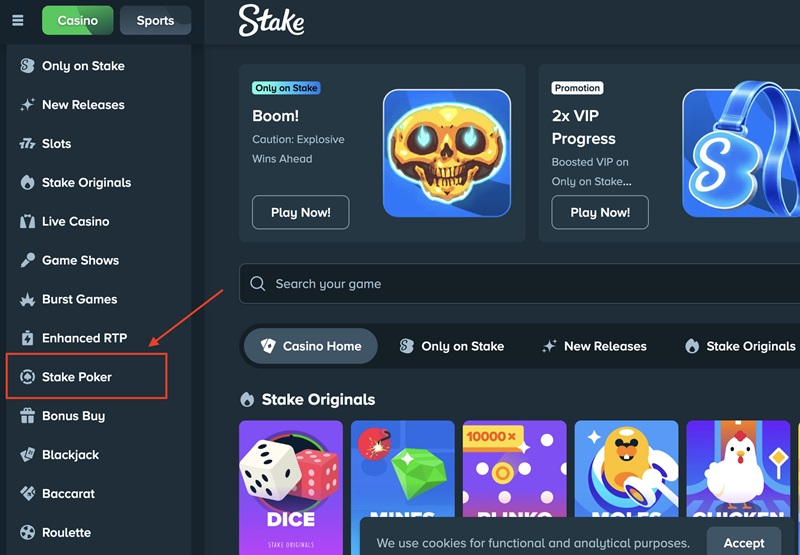
1. Locate the poker section: Go to the “Casino” with the top navigation and select the left side of the screen. There will be a Games tab, and you will see a link to “Stake Poker”, in addition to the slots, live casino, blackjack and all the other games listed to the right of the Stake Poker link. When you click on the Stake Poker link, you will be taken to the Poker Lobby.
2. Find a poker variant: In the Poker Lobby at the top of the screen, there are tabs for Hold’em, Omaha, Rummy, Tournaments and Sit & Go Poker. If you are a new player, Hold’em is the most popular choice. If you want to know more about how to play Stake Rummy, make sure to refer to a reputable site for info.
3. Examine the tables: Tables will be named after cities like London, Amsterdam and Bangkok. These tables will also show you the stakes, buy-in range and players currently playing.
4. Choose a table and compare to bankroll: All stakes are displayed in USD (not INR). Micro stakes start at $0.01/$0.02, and higher limits go all the way to $2.50/$5.
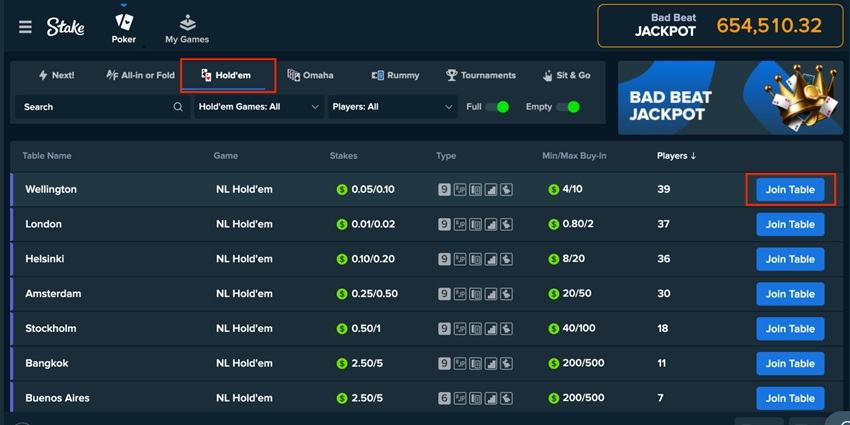
5. Join table: Select “Join Table” to get into a seat and confirm how much you bought in for (chip stack).
6. Wait for the next hand: Once seated, you will be dealt in at the next hand regardless of what is happening in the current hand.
7. Begin play: The cards will be dealt for you automatically, and when it is your turn you will see the options to fold, check, call or raise at the bottom of your screen.
Basic Rules of Stake Poker
When playing poker, it is important to know how a hand is played so you have a good understanding of how to switch from variance. The basic setup is the same in all games.
Each hand starts with two players making small forced bets called the small blind and the big blind. The dealer puts the blinds at the end of the round, but as a result of this, there will always be something in the pot to play for.
After that, each player gets their cards, and from there on out, one player at a time will take action.
When it is your turn, you have four options:
- Fold – discard your cards and exit the hand, losing only the amount already wagered.
- Check – pass your action without wagering. The only time you may do this is if nobody before you in that round has made a wager.
- Call – place enough to match what has previously been wagered by another player to continue playing in the hand.
- Raise – wager more than what has previously been wagered; other players must match your new wager, raise again, or fold.
There are multiple betting rounds in a poker hand. After each betting round has concluded, the dealer will turn over additional cards for players to look at. After all players have acted, everybody remaining in the hand reveals their cards and the player with the highest five-card combination wins the pot.
If everybody remaining in the hand folds before that point, you win the pot immediately, without having to show your hand.
You will use a standard 52-card deck; the cards are ranked 2 (lowest) through Ace (highest). There is a “dealer” button on the table which allows you to identify the dealer for that round. The dealer button moves one position to the left after every hand, so each time you play, you will be in a new position at the table.
Texas Hold’em Rules
Texas Hold’em, the world’s most popular poker game, is the one played on TV at all the Big Tournaments, including the WSOP. It is generally the first poker game a beginner learns to play.
At the beginning of each hand, players are dealt 2 hole cards (facedown, the player cannot show anyone else). Five community cards (facedown) will be dealt to the center of the table.
Community cards come out in three stages:
- 1st stage → 3 cards come out together (flop)
- 2nd stage → 1 card comes out (turn)
- 3rd stage → 1 card comes out (river)
Players will bet between each stage of the community cards. That gives 4 rounds of betting total.
Each player attempts to create their best possible 5-card hand combination from the 2 hole cards they received and the 5 community cards on the table.
Some players will use both cards; some will use only one, or no cards from their hand and only the community cards for their 5-card hand.
At Stake, Texas Hold’em games are played as No Limit (NL) Hold’em, meaning players have the ability to bet any amount they want, at any time, including betting all their chips in one bet (all-in). This is the most common form of Hold’em poker.
Omaha Rules
Omaha is similar to Texas Hold’em. You’ve still got blinds, four rounds of betting, five community cards, and a showdown at the end. The big difference is in your cards.
In Omaha, you’ve got four hole cards instead of two. But here’s the trick – when you construct your final five-card hand, you must use two of your hole cards (not fewer and not more) and three of the community cards. You can’t use just one of your hole cards or all four. This is a fixed rule, and it changes the way you think of your hand.
Since you start with more cards, the stronger hands tend to appear more frequently, and the pots tend to be bigger. A hand such as two pair, which often wins in Texas Hold’em, will almost always lose in Omaha if there’s more than one or two players still in the pot.
Stake offers all three varieties of Omaha:
- PL Omaha → four hole cards
- PL 5 Card Omaha → five hole cards
- PL 6 Card Omaha → six hole cards
All three are played as Pot Limit (PL), which means the most you can bet at any time is the current size of the pot. The two-cards-from-your-hand rule applies even in the 5-card and 6-card versions, although you have more cards to pick from.
Poker Gameplay Mechanics
When you join a table on Stake, the software takes care of everything else – dealing, betting order, and timing. All you need to concentrate on are your decisions.
Each hand begins with the dealer button moving to the next seat over and the blinds being posted. You’re dealt hole cards face down, visible only to you.
When it’s your turn, the action buttons are available:
- Fold
- Check
- Call
- or Raise.
A timer of 15 to 30 seconds counts down. If you fail to act in time, your hand is folded automatically. You have a slider available to determine your raise, and pre-action buttons like “Check/Fold” can be tapped ahead of time to speed up play.
As the hand progresses, the community cards are revealed in phases and the size of the pot is updated after every bet. If a player goes all-in, a side pot is created automatically – the all-in player is only eligible to win the main pot.
When you fold, your cards disappear, and you wait for the next hand. You can leave the table between hands and return later. At showdown, the remaining players’ cards are revealed automatically, and the pot is awarded to the winning hand with no work from you.
Scoring & Payouts
Stake Poker does not keep score with points. Your payout in any hand is simply the chips that were in the pot when you won it.
The pot is built from the blinds and by any betting, calling, or raising during play. If you win, the full pot is added to your chip stack. Stake does take a small slice rake from each pot as a commission for playing, but only for a hand that reaches the flop.
If both players show down the same hand, the pot is split. If you go all-in, side pots will be constructed so that each player can only win up to what they originally had in front of them.
You can cash out your chips at any stage between hands, and they are turned back to your wallet balance.
Poker Hands Ranking
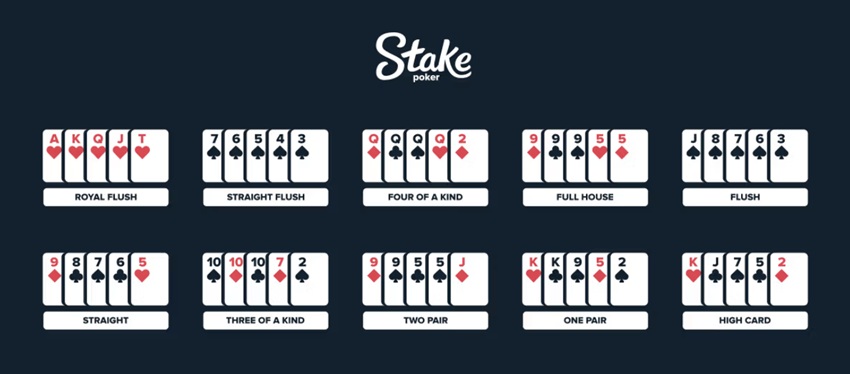
The most important thing you need to know in order to play poker is the ranking of the hands. These ranks are the same for all forms of poker on Stake. The following is a list of the rankings for poker hands:
- Royal Flush → A, K, Q, J, and 10 all from the same suit. This is the best possible hand in poker, and you will rarely see it.
- Straight Flush → 5 cards in a row that are also all from the same suit (for example, 6-7-8-9-10 clubs).
- Four of a Kind → 4 cards of the same rank (e.g., four Queens).
- Full House → 3 cards of the same rank plus two additional cards of the same rank (e.g., three Aces and two Sevens).
- Flush → 5 cards of the same suit that are not in a row.
- Straight → 5 cards that are in a row but that come from different suits (e.g., 4-5-6-7-8).
- Three of a Kind → 3 cards of the same rank.
- Two Pair → 2 pairs (e.g., 2 Jacks and 2 Fives).
- One Pair → 2 cards of the same rank.
- High Card → No matches. Whoever has the highest-ranked card in their hand wins.
If two players show down with the same hand, the higher card in that hand is the kicker and will determine who wins the pot. For example, two players both have a pair of Kings. Whoever has the higher second card would win the pot.
Stake Poker Strategies
Poker is a game of skill, but there are no guarantees that you will win, no matter how good you get. There is a real element of chance involved, and even the pros have streaks where they lose. Consider the tips below a starting off point at minimum:
- Be stingy with starting hands: Many newbies play too many hands, especially early on. Strong starters are high pocket pairs (AA, KK, QQ) and high suited connectors. Before the flop, don’t be afraid to drop weak hands.
- Pay attention to position: If you are in a later position, the fact that you’ve had time to act after all the other players builds knowledge. If you’re near the button, you can play more hands, but if you’re having to act first or second, you want to play fewer hands.
- Watch your bankroll: Sit at tables where the buy-in is only a small percentage of your bankroll. Generally, you want to hold twenty buy-ins for whatever stake you are playing, so one bad session won’t wipe you out.
Why Play Poker on Stake? Pros & Cons
Stake Poker has a number of features that might or might not work for you, depending on what it is you’re looking for in a poker site. Here’s the other side of the coin:
Pros
- Provably Fair: Stakes allow you to verify independently the results of every hand with cryptographic seeds, which most online poker options don’t do.
- Player Vs. Player: Rather than playing against the house, you’ll pit your skills against real users at the table.
- Multiple Variants in Each Place: Holdem, three Omaha variants, Sit & Go and tournaments, all on one platform without needing to switch to a separate dedicated poker room.
Cons
- Smaller player pool than dedicated poker rooms: Since Stake Poker is part of a wider platform and not a dedicated poker room, traffic, especially at higher stakes and less-presence variants, is thin during non-peak hours and the choices of tables are limited.
Stake Poker Promotions
Poker-related promotions run throughout the entire site at Stake, including the Stake Daily Races. It has a daily prize pool of $100,000, which top 5,000 players on the leaderboard can participate in via their wagers in casino games, poker and sports.
All new players can also get a welcome deposit match bonus of 200% up to ₹120,000 at the time of sign-up using our code CSTAKE (18+, T&Cs apply). The Promotions area of Stake.com has full details of all offers, including bonus codes, deposit limits and wagering requirements.
Stake Poker FAQs
Is Stake Poker legal in India?
Online real-money poker sits in a grey area in India, with rules varying by state. Stake operates under a Curaçao gaming licence and is accessible to most Indian players. Check the laws in your own state before playing.
What is the best hand in Stake Poker?
The Royal Flush – A, K, Q, J, 10 of the same suit. It is the strongest hand in poker that no one can beat.
Can I play Stake Poker for free?
Cash tables run on real money only. However, Stake hosts daily freerolls like tournaments with no buy-in but real prize pools. You may find this under the “Tournaments” tab.
Can I withdraw my winnings from Stake Poker?
Yes. However, you can withdraw your winnings through the same method you used for the deposit, after completing KYC. Please play responsibly and seek help if gambling starts affecting your finances or daily life.